


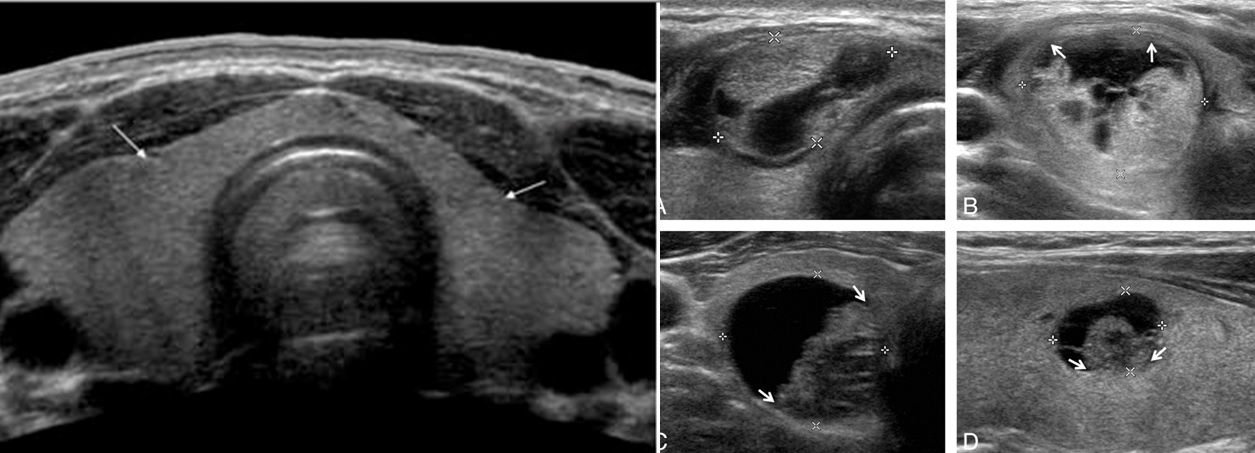
What is Thyroid Ultrasound?
Thyroid ultrasound is a safe and painless radiology examination. It creates images of the body using sound waves. Ultrasound exams do not use ionizing radiation, so the patient is not exposed to radiation. Since ultrasound images are real-time images, they can show the structure and movement of the body’s internal organs, as well as the blood flow in blood vessels.
Ultrasound imaging is a non-invasive medical imaging technique that helps doctors diagnose and treat medical conditions. Thyroid ultrasound is the imaging of the thyroid gland and the adjacent structures in the neck.
The thyroid gland is located at the front of the neck, just above the collarbones, and has a lobe on each side of the neck, resembling a butterfly. It is one of nine endocrine glands in the body that send hormones into the bloodstream.
The thyroid gland produces thyroid hormone, which helps regulate various body functions, including how fast the heart beats. It is very common for nodules to develop that may be felt on the surface of the skin or detected only with ultrasound.
About 5-10% of adults have nodules in their thyroids that can be detected by a doctor during an examination. These are called palpable nodules. Ultrasound is very sensitive to non-palpable nodules, and it can clearly show nodules that cannot be felt.
In some age groups, such as in about 70% of adults, nodules can be detected on ultrasound. Most of these are benign thyroid tissue nodules that pose no health risk. A small portion of these nodules, however, are actual thyroid tumors that may require further diagnosis or treatment.
What are the Common Uses of Thyroid Ultrasound?
To determine whether a lump in the neck is originating from the thyroid gland or other nearby structures.
To analyze the appearance of thyroid nodules and determine if they are more likely to be benign, common nodules or have features that may require a biopsy.
If a biopsy is needed, ultrasound guidance during a fine-needle aspiration biopsy helps improve accuracy. It is also used to search for additional nodules in patients with one or more palpable nodules detected during a physical exam. It can track how much a thyroid nodule grows over time.
Because ultrasound provides real-time images, it can also guide procedures such as thyroid needle biopsies. Ultrasound can also be used to guide the placement of a catheter or other drainage device.
How Should I Prepare for a Thyroid Ultrasound?
You should wear comfortable, loose-fitting clothing for your ultrasound examination. You may need to remove all clothing and jewelry in the area to be examined. No other preparation is necessary. Ultrasound exams are highly sensitive to movement, and a restless or crying child can prolong the exam process.
To ensure a smooth examination, it can be helpful to explain the procedure to the child before the exam. Bringing books, small toys, music, or games can help distract the child and make the time pass quickly.
How is a Thyroid Ultrasound Performed?
You will be positioned on the examination table, lying face-up. A pillow may be placed under the shoulders to extend the area being scanned, which is especially important for small children who have limited space between the chin and chest.
Once you are positioned on the table, the radiologist will apply a water-based gel to the area of the body being examined. Ultrasound exams are painless and are easily tolerated by most patients.
A thyroid ultrasound is typically completed within 20 minutes. Once the exam is finished, you may be asked to get dressed and wait while the ultrasound images are reviewed. After the ultrasound examination, you can return to your normal activities.
What Are the Benefits and Risks of Thyroid Ultrasound?
Ultrasound is widely used, easy to use, and less expensive than other imaging methods. Ultrasound imaging is extremely safe and does not use any ionizing radiation. Ultrasound provides clear images of soft tissues that do not show well on X-ray images.
Since ultrasound is a real-time imaging technique, it is used to guide minimally invasive procedures such as needle biopsies and fluid aspiration. There are no known harmful effects on humans for standard diagnostic ultrasound.
What Are the Limitations of Thyroid Ultrasound?
If a nodule is detected in the thyroid gland, the radiologist will examine the characteristics of the nodules. Some features suggest that a nodule is benign, while others may indicate that the nodule could be a malignant tumor. In some cases, the radiologist may not be able to make a definite distinction between benign and malignant masses.
In such cases, a thyroid fine-needle biopsy with histopathological evaluation is required. In some cases, a follow-up thyroid ultrasound may be needed 2-3 months later to detect any increase in the size of the nodule.
Thyroid ultrasound cannot determine thyroid function – it cannot tell if the thyroid is underactive, normal, or overactive. To determine this, your doctor may order a blood test or a thyroid scan.
Thyroid Ultrasound Prices 2026
Thyroid ultrasound prices 2026 – for more information, you can contact us immediately.
Dr. Abdullah Cevahir
Radiology Specialist
Hekimoğlu Imaging and Diagnostic Center