


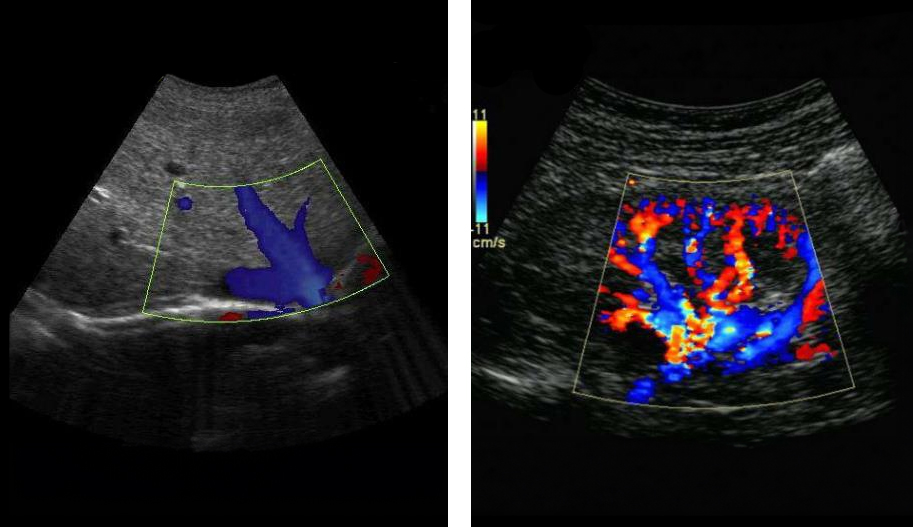
Transrectal Color Doppler Ultrasonography (TRUS)
The prostate is part of the male reproductive system. It is a walnut-sized gland located below the bladder and in front of the rectum in men. It surrounds the urethra (the tube that carries urine and semen out of the body). Prostate tissue produces part of the seminal fluid (the fluid that combines with sperm to form semen). Prostate-specific antigen (PSA) is a protein made by prostate tissue and found in the blood. Three conditions can affect the prostate, causing issues with urination and elevated PSA levels. These include prostate infection, a condition known as prostatitis, benign prostate enlargement, also known as BPH (benign prostatic hyperplasia), and prostate cancer.
TRUS, also known as prostate color Doppler ultrasound, is a method that creates detailed images allowing the doctor to evaluate the size of the prostate.
Transrectal color Doppler ultrasonography has advantages such as providing real-time imaging and being relatively inexpensive, although its specificity is low, especially for inexperienced users.
Why is Transrectal Color Doppler Ultrasound Performed?
– General evaluation of the prostate gland
– Findings from a rectal exam suggestive of prostate cancer
– Blood test results indicating potential prostate cancer
– Diagnosis of certain cancers
– Locating and examining the size of a tumor in the anus or rectum
– Evaluating whether a tumor has spread to lymph nodes or other tissues
– Assessing benign conditions such as prostate cysts
– Assisting in the collection of prostate tissue samples for biopsy in men
Prostate cancer typically appears hypoechoic on gray-scale ultrasound, with about 30% appearing isoechoic and 1% hyperechoic. Many prostate cancers cannot be seen on standard ultrasound exams. Irregularities or extensions seen in the prostate capsule can be interpreted as extracapsular extension. Although information gained about capsular invasion is a significant determinant in TRUS staging, it provides limited information about the spread and differentiation of the disease. Even if a biopsy result comes back negative, prostate cancer cannot be completely ruled out.

A randomized biopsy guided by transrectal ultrasonography is the gold standard method for histological diagnosis of prostate cancer. It is currently recommended to take 10-12 samples during TRUS-guided biopsy. Prostate cancer can present as multifocal in more than 85% of cases, and unnecessary biopsies can lead to increased complications. Even if a TRUS-guided biopsy is negative (up to 35% of cancers may be missed), prostate cancer cannot be completely ruled out if clinical suspicion persists. For this reason, instead of increasing the number of biopsies, research is being conducted to improve the quality of the examination to reduce the number of unnecessary blind biopsies.
Benign prostate findings, characterized by the proliferation of smooth muscle and epithelial cells in the transitional zone, cause lower urinary tract symptoms. Transabdominal ultrasound (TAUS) is useful for detecting cases where the prostate protrudes into the bladder and calculating prostate volume. In 95% of cases with prostate volumes exceeding 40 grams, bladder outlet obstruction is detected via pressure-flow studies. TRUS is the most frequently used imaging method for prostate diseases and is the best imaging modality for measuring prostate volume in patients scheduled for surgery, providing more accurate data than TAUS. The prostate gland is supplied by the urethral and capsular arteries. In BPH, due to the compression of the enlarged transitional zone, a resistive index above 0.75 in the capsular artery on TRUS Doppler examination is considered the threshold value for bladder outlet obstruction. TRUS elastography can differentiate prostate cancer, as cancerous tissue is firmer than normal prostate tissue. The zonal anatomy of the prostate cannot be seen on computed tomography (CT). Prostate enlargement and protrusion into the bladder base can be observed, but BPH and prostate cancer cannot be distinguished.
Transrectal Color Doppler Prices 2026
Transrectal color Doppler prices vary regionally. Even within the same region, prices can differ between private centers. You can call us to get detailed information about pricing at 02126321060.