


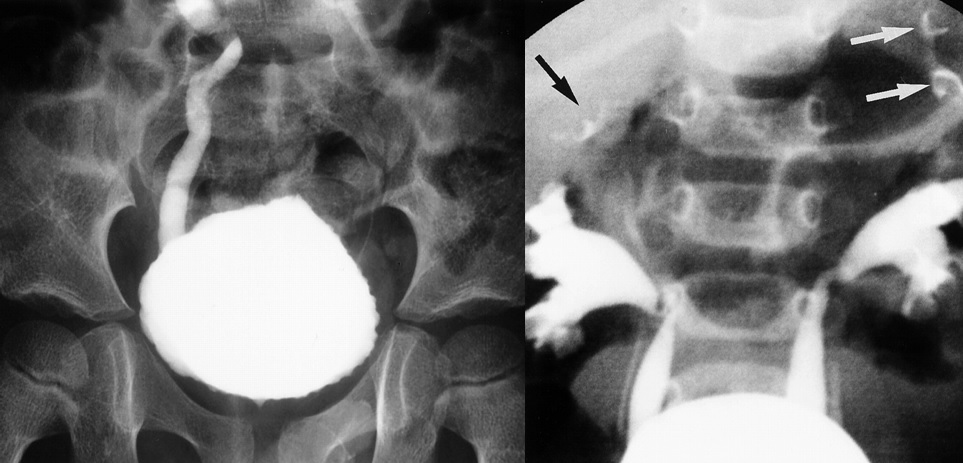
What is a Voiding Cystourethrography?
Voiding cystourethrography is the most commonly used imaging method for evaluating the female urethra and the male posterior urethra. Cystourethrography is performed after the bladder is filled with contrast material through a transurethral catheter.
Voiding cystourethrography is an imaging test that can help diagnose issues with your bladder. It uses X-rays.
During a voiding cystourethrography, your doctor will insert a thin tube called a urinary catheter and inject contrast material into your bladder. The contrast material allows your doctor to see your bladder more clearly. They will take X-rays of your bladder. Voiding cystourethrography is sometimes combined with other procedures. For example, cystourethrography images the bladder and urethra. Your doctor may also use fluoroscopy to watch how the bladder empties during urination (voiding cystourethrography). The procedure can show if any urine is flowing back into the kidneys (vesicoureteral reflux). Computed tomography (CT) voiding cystourethrography is sometimes used after trauma or recent surgeries.
X-rays use a small amount of radiation to create images of your bones and internal organs. X-rays are mostly used to find bone or joint problems or check the heart and lungs. Voiding cystourethrography is a type of X-ray.
After the transurethral catheter is removed, spot radiographs of the bladder and urethra are taken while the patient urinates under fluoroscopic observation. During active urination, the bladder neck opens widely and forms a funnel shape in both male and female patients due to the internal sphincter mechanism.
In male patients, the verumontanum appears elongated, and the proximal bulbar urethra has a less conical appearance. However, the membranous urethra remains the narrowest segment between these parts, even though it can expand to a diameter of 6 or 7 mm during urination.
Voiding cystourethrography may not show certain abnormalities in the anterior urethra of males because the normal anterior urethra cannot be visualized as well as in retrograde urethrography.
Retrograde urethrography is the best way to evaluate the anterior urethra, while voiding cystourethrography is the most suitable method for assessing the posterior urethra.
Why Is Voiding Cystourethrography Done?
You may need voiding cystourethrography to determine the cause of the following:
Blood in your urine (hematuria), recurrent urinary tract infections, trouble emptying your bladder, urinary reflux, when urine flows back into one or both ureters and in some cases into one or both kidneys, incontinence.
Other reasons for needing voiding cystourethrography include:
Bladder trauma. The test will allow your doctor to see if there is a tear in your bladder wall.
Obstruction or narrowing (strictures) of the ureters or urethra.
Before or after certain spine surgeries. This will allow your doctor to see possible issues with the nerves leading from the spine to the bladder.
Inform Your Doctor If You Have Any of the Following:
You are pregnant or think you may be pregnant. Exposure to radiation during pregnancy can cause birth defects.
You have allergies or sensitivities to medications, contrast dyes, local anesthesia, iodine, or latex.
You have kidney failure or other kidney problems.
Since a thin tube (catheter) will be inserted into your bladder during the test, you are at risk of a bladder infection. The catheter can also cause bleeding or hematuria.
How Do I Prepare for Voiding Cystourethrography?
Your doctor will explain the procedure to you. Ask any questions you have about the procedure.
You may be asked to sign a consent form that gives permission to perform the procedure.
You may need to stop eating and drinking before the test. Your doctor will give you specific instructions. In general, this means no food after midnight and only clear liquids on the day of the test. You may be asked to drink additional clear fluids the day before and on the day of the procedure.
If you are pregnant or think you might be pregnant, tell your doctor.
Tell your doctor if you have ever had a reaction to contrast material or if you are allergic to iodine.
Let your doctor know if you are sensitive to or allergic to any medications, latex, tape, or anesthetic agents (local and general).
Provide your doctor with a list of all medications you are taking, including prescriptions, over-the-counter drugs, and herbal supplements.
Tell your doctor if you have a bleeding disorder. If you are taking blood-thinning medications (anticoagulants), aspirin, or other drugs that affect blood clotting, let your doctor know. You may need to stop these medications before the test.
You may be told to take a laxative the night before the test. Or, you may be given an enema or medication to help you have a bowel movement on the morning of the test.
Follow any other instructions your doctor gives you for preparation.
How Is Voiding Cystourethrography Done?
You will be asked to remove any clothing, jewelry, or other objects that might interfere with the images.
You may be asked to remove your clothing. If so, you will be given a gown to wear.
You will lie on your back on the X-ray table.
Your doctor will insert a thin tube (catheter) into your bladder. They will use it to inject contrast material into your bladder.
Your doctor will take X-rays of the kidneys, ureters, and bladder (KUB) to make sure they can see the urinary system.
They will inject the contrast material into the bladder through the catheter. To prevent the contrast material from leaking out of the bladder, they will clamp the catheter tube.
They will take X-rays while the contrast material is injected and afterward. You may be asked to change positions for different X-ray images of the urinary system.
Your doctor will remove the catheter, and you will be asked to urinate. Your doctor will take X-ray or fluoroscopy images while you urinate. If you cannot urinate while lying down, you may be allowed to sit or stand.
Voiding Cystourethrography Prices 2026
In Istanbul, voiding cystourethrography prices vary from region to region and even between institutions in the same area. For information on voiding cystourethrography prices, you can call 02126321059.